SOAP Notes in Seconds: How AI Medical Scribes Are Saving Providers 2+ Hours Daily
Documentation burnout is the #1 reason physicians leave practice. AI scribes trained on real clinical data are changing that — here's the before and after.
The Documentation Crisis
For every hour of patient care, physicians spend nearly two hours on documentation. That's not a typo. The average provider spends 1-2 hours after clinic writing notes, and 15-30 minutes per patient encounter on EHR data entry during visits.
The result? Provider burnout is at an all-time high. 63% of physicians report burnout symptoms, and documentation burden is consistently the #1 cited cause. It's also the leading reason physicians reduce their patient panels, cut hours, or leave practice entirely.
What AI Medical Scribes Do Differently
Traditional scribes — whether in-person or virtual — are human. They listen to encounters and type notes in real-time. They're effective but expensive ($25-45/hour), inconsistent, and require training on each provider's style.
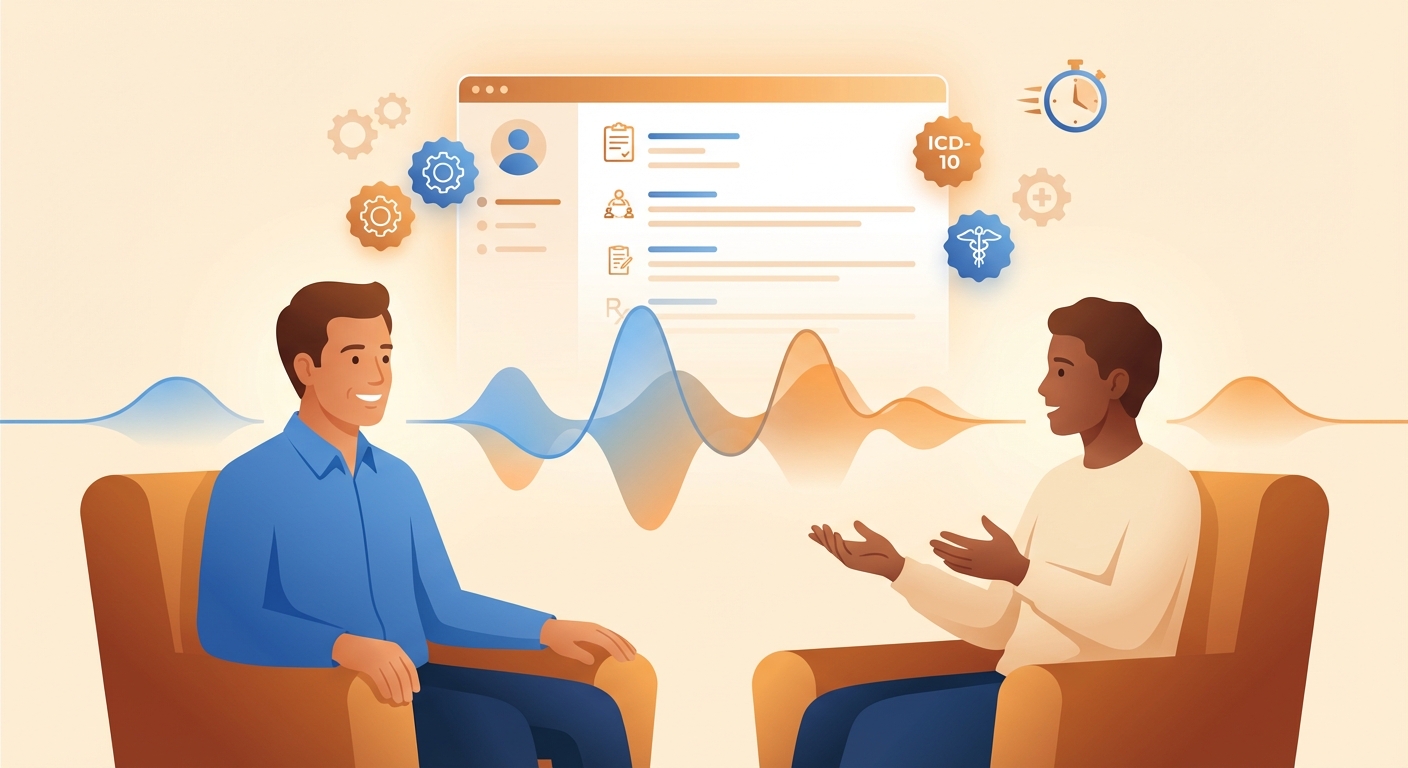
AI scribes work differently. They listen to the natural conversation between provider and patient, then generate structured clinical notes automatically. No templates to fill out. No clicking through EHR fields. Just talk to your patient like you normally would, and the note writes itself.
Here's the workflow:
- Step 1: Start the encounter. The AI listens via your phone, tablet, or computer microphone.
- Step 2: Conduct your visit normally. Ask questions, perform your exam, discuss treatment. The AI captures everything relevant.
- Step 3: End the encounter. Within 30-60 seconds, a complete SOAP note appears — structured, coded, and ready for your review.
- Step 4: Review and sign. Make any adjustments, then push to your EHR.
SOAP Note Quality: AI vs. Manual
The biggest concern providers have is quality. "Can AI really write notes as well as I do?" The honest answer: in many cases, better.
Here's why:
- Consistency. AI doesn't get tired at 4 PM. Note quality at the end of the day matches the beginning. No shortcuts, no "will complete later" that never gets completed.
- Completeness. AI captures details you might forget to document — that off-hand mention of a new medication, the patient's comment about worsening sleep, the social history update.
- Coding accuracy. AI maps findings to appropriate ICD-10 and CPT codes, reducing undercoding (lost revenue) and overcoding (compliance risk).
- Structured output. Every note follows proper SOAP format with clear Subjective, Objective, Assessment, and Plan sections.
Specialty-Specific Intelligence
Generic AI note-taking tools fall short in healthcare because medical documentation is specialty-specific. A chiropractic SOAP note looks nothing like a psychiatric evaluation or a surgical operative report.
The best AI scribes are trained on specialty-specific
- Chiropractic: Spinal segment documentation, subluxation findings, adjustment techniques, rehab protocols
- Primary Care: HPI elements, review of systems, medication reconciliation, preventive care gaps
- Physical Therapy: Functional assessments, exercise prescriptions, progress measurements, outcome scores
- Mental Health: MSE findings, risk assessments, therapeutic interventions, safety planning
- Dental: Tooth-specific findings, periodontal charting, treatment planning, material documentation
The Numbers That Matter
Practices using AI scribes report consistent improvements:
- 2+ hours saved daily per provider on documentation
- 20-30% more patients seen without extending hours
- 90%+ provider satisfaction — most say they'd never go back to manual notes
- 15-20% revenue increase from more accurate coding and reduced missed charges
- Near-zero after-hours charting — notes are done before the patient leaves
Privacy and Compliance
Patient audio being processed by AI raises obvious HIPAA concerns. Here's what a compliant AI scribe implementation looks like:
- Audio is encrypted in transit and at rest
- Processing happens on HIPAA-compliant infrastructure with a signed BAA
- Audio is deleted after note generation (no permanent storage of recordings)
- Patient consent is obtained and documented
- The AI never shares data between practices or uses patient data for model training
Getting Started Is Easier Than You Think
Most providers are documenting with an AI scribe within their first day. There's no complex EHR integration required to start — you can use it standalone and copy-paste notes into your system. As you get comfortable, deeper integrations with your EHR can be configured.
The providers who adopt AI scribing today aren't just saving time — they're rediscovering why they went into medicine in the first place. More eye contact. More listening. More healing. Less typing.